Mayor Keisha Lance Bottoms offered free and confidential HIV testing on Nov. 30, 2018, at Atlanta’s city hall. The service provided in partnership with AID Atlanta was a way for Bottoms to promote HIV & AIDS awareness throughout the city.
According
to data from the Fulton County Department of HIV Elimination, over
40,000 people carried cases of HIV across metro Atlanta in 2017. Efforts
by local and state government officials have shown they are ready to
fight the growing crisis.
Eldredge Washington, community liaison for the West Care Foundation, helps educate students at Georgia State about HIV prevention and care during a free HIV testing event on Sep. 17
Eldredge
Washington watches as hundreds of students walk in and out of the black
curtains in front of him on Georgia State’s campus. Behind those curtains,
people are taking advantage of the free HIV testing that is being offered by
the school and the West Care Foundation.
Washington hopes that events like this will help remove the negativity surrounding HIV so people who are infected can get the care they need. “The number one thing is removing the stigma of testing. More people need to get tested because it not only gives people their status, but it allows us to educate them,” he said.
Washington talking to a group of young men after a meeting for Black Men Lab on Oct. 7.
Washington is one man out of hundreds of people who are trying to teach Atlanta about HIV prevention and care. “Young people are a big cause for me, but this is something that is a natural epidemic, and the community needs to fight,” he said.
According to the Fulton County Board of Health, in 2017, there were over 40,000 prevalent cases of HIV in metro Atlanta. Men were the predominant carriers of the virus, with a 79% infection rate and 67.4% of transmissions happening with male-to-male sexual contact. The black community was also disproportionately affected, carrying 69.7% of the prevalent cases.
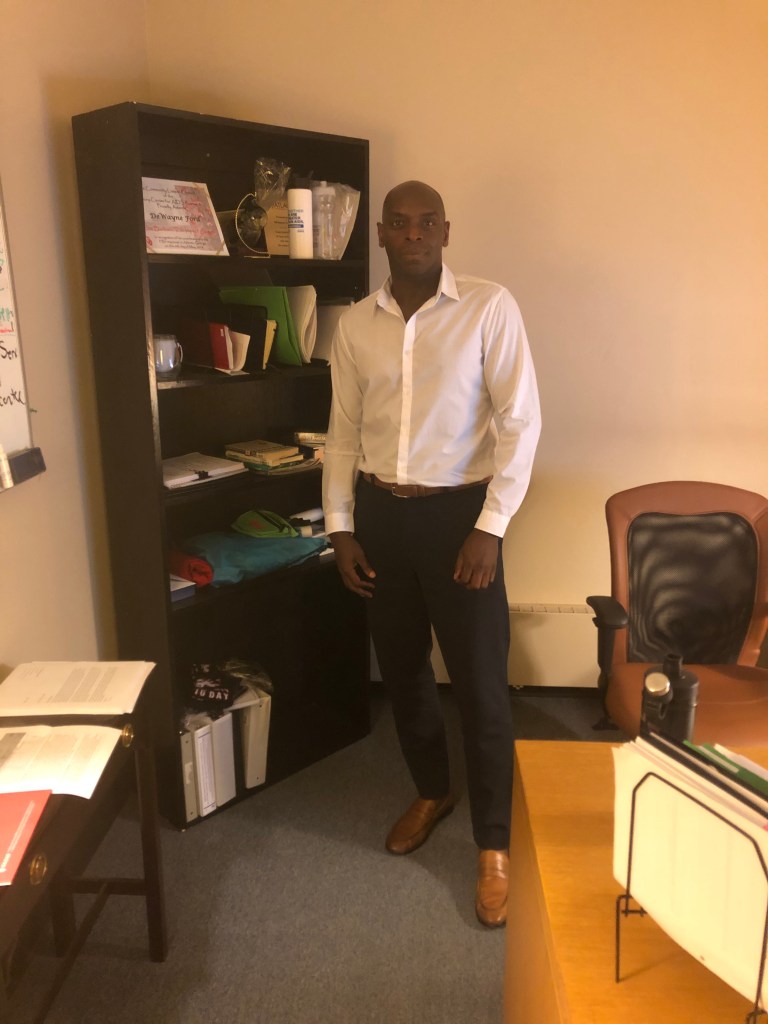
DeWayne Ford, director of prevention services for AID Atlanta shares the importance of HIV prevention and care with communities throughout Atlanta.
DeWayne Ford, director of prevention services for AID Atlanta, says lack of testing is one reason that HIV is effecting so many people in the city. “HIV is a very hard virus to contract as with any real pathogen type virus. Research shows that if a person doesn’t know they have the virus, they could unknowingly transmit the virus to their partner as HIV symptoms are often asymptomatic,” he says.
Ford says the message of HIV prevention is important. “The prevention message goes with in the care message. If a person goes out and gets the tools they need like consistent condom usage or PrEP, then that person can remain HIV negative. If a person is HIV positive and can access care, start an ARV (antiretroviral treatment) and take the medicine prescribed, viral suppression will happen. These two risk reduction methods, when used properly, eliminates the possibility of HIV transmission,” he said.
One
of the most important elements both Ford and Washington like to rely on to
prevent HIV transmission is proper education about safe sex and the virus.
Washington emphasizes how education is just as important for younger
generations as it is for the older ones.
“The approach is different, but the message is the same. There are a lot of people, both young and old, who are very uneducated about how sex is related to the transmission of HIV. The message is almost the same, but the delivery is different. We have [a] curriculum that works with young people, wherewith older adults it may be a group conversation or a one-on-one conversation,” says Washington.
In his journey, Washington is finding encouragement in several bills that were passed in Georgia Assembly and signed into law by Governor Brian Kemp. House Bill 217 creates the groundwork for a clean needle exchange program, and House Bill 290 helps creates a pilot program for the PrEP pill. “I think that once you begin to marry legislation with real change, you’ll begin to see a difference, and that’s what you see there. I do think that when you start thinking about treatment and what it takes to get people back to being safe and healthy, we have to be aggressive,” says Washington.


 Ben Abrams